simple
treasures of Santorini simple
treasures of Santorini
1864 The Sea Captain's House &
Spa,
in Greek 'Kapetanospito', was built by the Sigouras Sarris family after the Greek War
of Independence from the Turkish rule. It was completed the same
year as the signing
of the new Constitution of Greece. A triangular, marble plaque
set in the red stone facade
proudly announces the house's commemorative date and the
owner's family initials "S.P.A." - Σ.
Π. Α.
The Sarris family was a
renowned ship-owners family from Oia. The owners two sons and
grandson continued the seafaring family tradition until the era of
the steam engine which replaced the proud sailing ships.
This is one of only eight homes directly on the Oia caldera that
are officially designated
by the Greek Ministry of Culture as examples of traditional
architecture and protected for conservation.
The noted architect, Dimitris Philippides in his book "Three
Centuries of Architectural Style
- Greek Design and Decoration" refers to it specifically:
The "sea captain's house with dark volcanic stone
used for decorative purposes in conjunction with white marble
aperture frames for the upper storey;
in contrast, simple painted plaster is used for the veranda and
the lower storeys.
This Western-style decoration may have Renaissance roots and is
found nowhere else in Greece.
Although not yet documented, the house's
external plan was probably brought back proudly
to Oia ( Ia ) by the owner from his many voyages to Renaissance
Italy as captain of the "Panagia Platsani" from 1846.
The upper facade gives the typical Renaissance illusion of two
floors - the lower level having a smooth,
stone-like plaster finish and the upper level faced with hand-cut
red stones thrown out from the volcano.
Both levels joined together by six faux pillars cut from
'kokinopetra', the volcanic red stones - with marble capitals.
Below - the lower facade's two arched doorways tower over the
Courtyard. The arches are outlined with red stones
and supported by pillars faced with the same volcanic stones. The
plaster wall is a light earthy yellow color,
with a fine, skillfully crafted and polished patina - almost a lost
art on the island. Restored in 2002.
The interior layout
incorporated the local Santorini elements: high, cross vaulted
ceilings,
walls built from black and red volcanic stones and strong pumice
cement, rooms carved into the cliff's rocks
and the traditional window over the outer and inner doorways -
perfectly
balanced to the eye yet practical for the purpose of maximum air
circulation.
Inside the house, furniture brought from abroad as well as
pieces crafted on the island for the past and current owners.
Unique to the sea captain's houses were the wide, wood planked floors. Probably
fitted by the same local carpenters who built the sailing ships
in the harbor below.
A peaceful house, with it's grand exterior of two terraces - each
positioned as
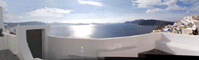
the ship's bow facing directly into the sea.
And a courtyard framed by simple, white walls - filled with
midnight stars and the afternoon sun.
Through time - the house's marble plaque was slightly altered to
show "S.P.A.F".
The additional 'F' added by the new owner. (Σ. Π. Α. Φ.)
Unlike Egypt, where the new phero could painlessly rub out all
initials and hieroglyphic images
of the previous ruler, usually his own father, - here a high
respect and
tradition is carried on by the new residents.
Santorini's commerce in
these years was based on the vine.
The vineyards were just outside Oia ( Ia ) in Baxedes beach and
Finikia, the agricultural 'suburbs'.
Often the sea captain had three business locations -
his ship, the home in Oia and the vineyard in Finikia.
The ship was flexible and always ready.
The house in Oia served as the party-centre for family, friends,
sailing crew
and new recruits when he was back from the long voyages.
The 'canavas' - the wine cave cellars - of Finikia produced and
held his wine.
A smaller version of the canava was also located inside the sea
captain's home
for convenience to store his wine and for prestige.
Sea, wine,
trade, tomato and the volcano.
Look around Oia and they are all still here - years later.
Come inside the Kapetanospito ~ 1864~ The Sea Captain's House and we will take
you back in time to enjoy these simple treasures.
1864 The Sea
Captain's House & Spa - Kapetanospito in Ia Oia Santorini
|
 |